
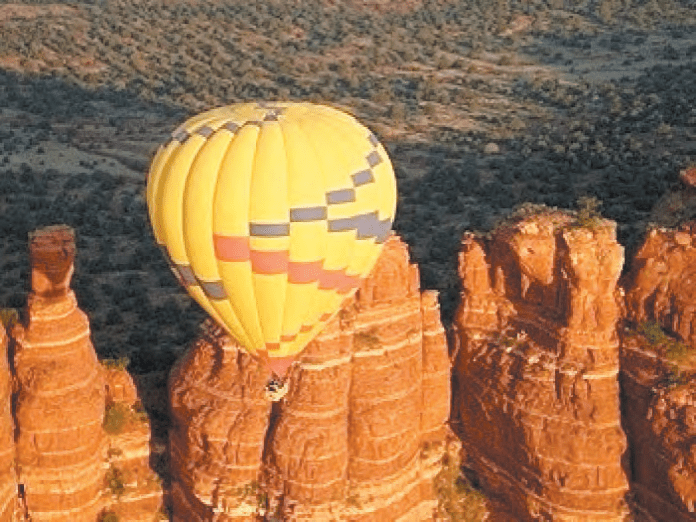
Up, Up, and Away in the Verde Valley Way
Few experiences in the Verde Valley match the quiet thrill of rising gently above the landscape in a hot air balloon. As the sun crests over Sedona’s red rocks, the desert floor glows in shades of rust, gold, and deep green – offering a perspective that feels both expansive and unexpectedly intimate.
Hot air ballooning is one of the oldest forms of human flight, dating back to the late 18th century. Yet despite its long history, the experience remains timeless. Unlike airplanes or helicopters, balloons move with the wind, creating a sensation less like flying and more like floating. There is no engine noise – only the occasional burst of the burner and the soft sounds of the landscape below.
In Northern Arizona, ballooning takes on a distinctive character. The Verde Valley’s varied terrain—rivers, vineyards, high desert, and dramatic red rock formations—creates a constantly changing visual experience. From above, familiar landmarks transform into sweeping patterns of color and texture, revealing just how diverse the region truly is.

Flights typically take place in the early morning hours, when cooler temperatures and calmer winds provide ideal conditions. As balloons lift off just after sunrise, passengers are treated to some of the most striking light of the day. Shadows stretch across canyons, and shifting sunlight brings out the depth and contours of the rock formations in ways that are impossible to see from the ground.
For many first-time passengers, the most surprising aspect of ballooning is how peaceful it feels. “Nobody has ever been scared once in the air,” says longtime pilot Mark Stewart. “People may feel nervous before takeoff, but once you’re up there, it’s calm. The basket feels secure, and you’re simply moving with the wind.”
That calm experience is the result of careful planning and expertise. Pilots must evaluate weather conditions, wind patterns, and terrain before every flight. Ballooning is entirely dependent on nature, and each journey is unique—no two flights follow the same path.
Stewart, who has been flying for more than three decades, describes the experience as both joyful and meaningful. “You’re working in an environment where people are already excited,” he says. “Sometimes it’s a celebration—an anniversary, a birthday, even a bucket list moment. You see a lot of smiles.”

While the experience feels effortless, it’s supported by a strong safety culture. “Safety is number one,” Stewart explains. “It all comes down to wind and how it interacts with the terrain. You respect that, and you make the right decisions.”
As tourism in the Verde Valley continues to grow, hot air ballooning remains one of its most memorable offerings. It’s not just about the view – it’s about perspective. From above, the valley reveals itself in a way that reshapes how visitors understand the landscape below. For those looking to experience the Verde Valley from a different vantage point, there may be no better way than to rise with the morning air—and take it all in.
Images courtesy of Red Rock Balloons
Ballooning: Quick Facts
- Ballooning dates back to the late 1700s
- Balloons move with the wind, not against it
- No engine = minimal noise and turbulence
- Fear of heights is rarely an issue once airborne
- Motion sickness is extremely uncommon
- Every flight path is different
What to Expect on a Balloon Flight
- Total Time: About 3–4 hours
- Time in Air: Approximately 1 hour
- Best Time: Early morning
(sunrise conditions)
- Takeoff: From varying locations based on wind conditions
- Landing: Changes each flight depending on wind direction
- Post-Flight: Equipment breakdown
- traditional champagne toast


Leave a comment